Clinical Mechanism & How It Works
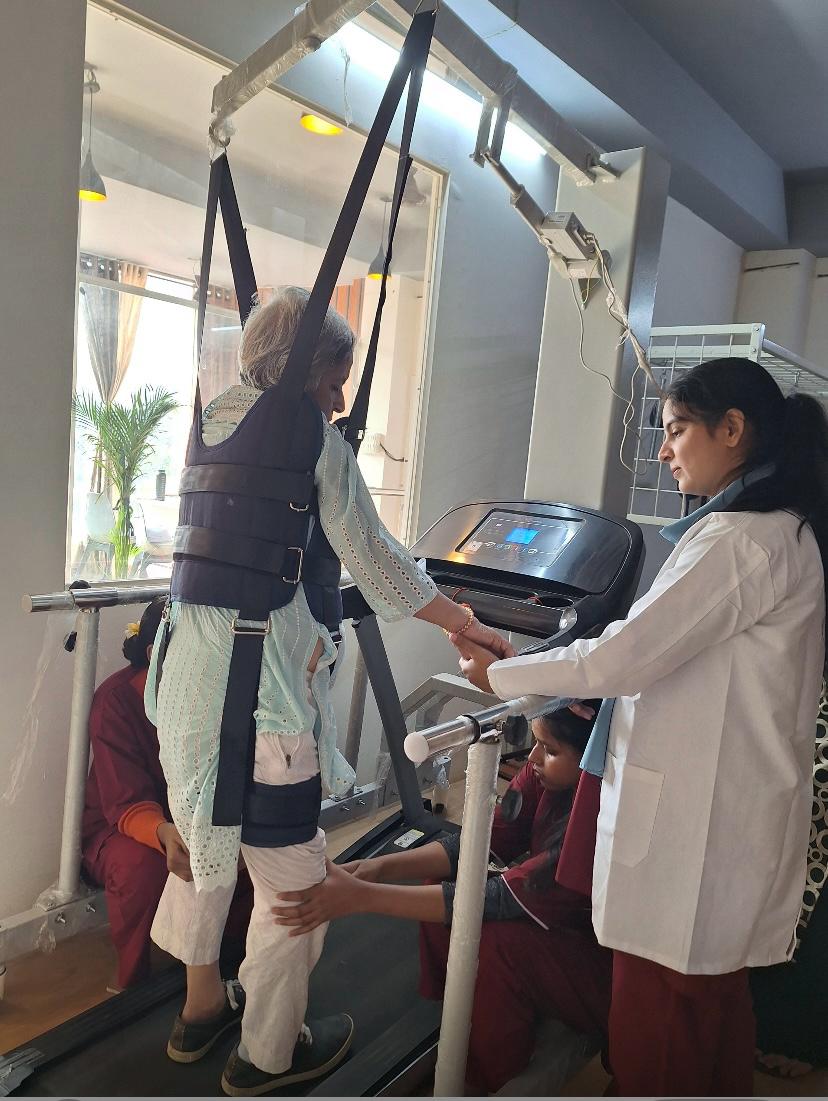
The Robotic Gait Trainer is an advanced neuro-rehabilitation system engineered to assist patients with impaired mobility in relearning physiological walking patterns. Combining dynamic body-weight support, motorized robotic leg orthoses (exoskeleton), and an integrated medical treadmill, the system guides the lower limbs through natural, symmetrical gait cycles.
Patients are securely supported via an ergonomic harness, eliminating the fear of falling while offloading a calibrated percentage of body weight. As the robotic orthoses drive repetitive, high-intensity stepping movements, integrated sensory feedback and interactive virtual environments stimulate neuroplasticity—encouraging the brain and spinal cord to rebuild neural pathways for locomotion. Real-time biofeedback continuously monitors patient active effort, automatically adjusting assistance levels to optimize clinical outcomes.
Technical Features & Specifications
Dynamic Body-Weight Support System (BWSS)
Features an automated, stepless weight-unloading suspension system that adjusts in real time to mimic natural vertical pelvic displacement during walking, ensuring patient safety and reduced joint loading.
Anatomically Adjustable Robotic Exoskeleton
Motorized, fully synchronized hip and knee orthoses that adapt to individual patient leg lengths, pelvic widths, and range-of-motion limits to deliver precise physiological gait trajectories.
Assist-as-Needed (AAN) Sensor Technology
Advanced force transducers measure patient-generated torque and effort, dynamically scaling robotic assistance so patients actively engage their muscles rather than relying solely on passive movement.
Interactive Biofeedback & Visual Simulation
An integrated front display offers immersive 2D/3D virtual environments and real-time performance metrics (stride length, symmetry, muscle recruitment), driving cognitive engagement and gamified therapy.
Integrated Synchronized Medical Treadmill
Treadmill speed precisely syncs with robotic leg speed ranging from low initial speeds (0.1 km/h) up to functional walking speeds, allowing safe progressive therapy.
Patient & Clinical Recovery Benefits
Accelerated Neuroplasticity Through High-Repetition Training
Delivers hundreds of symmetrical, physiologically correct steps in a single session—far exceeding conventional physical therapy—driving faster central nervous system reorganization and motor relearning.
Safe, Early-Stage Mobilization
Enables non-ambulatory and severely impaired patients (e.g., following stroke or spinal cord injury) to stand and walk early in the recovery timeline without fall risk.